Hot-melt adhesive
Hot Melt adhesive constitutes a cutting-edge solution for production lines requiring instantaneous assembly speed. Unlike liquid solutions, it presents in a solid form at room temperature and requires no drying time through evaporation: the adhesive bond forms simply by the cooling of the molten polymer. The ACROBOND range is specifically formulated to meet the high production rates of packaging, POS displays, joinery, and technical component assembly, offering immediate fixation without the constraints associated with solvents.
View more
Thermoplastic Technology in Industrial Environments
The transition to Hot Melt technology responds to strict productivity and safety requirements. These 100% solid adhesives are highly favoured for their ease of implementation and storage stability.
-
Maximum Productivity: ACROBOND Hot Melt adhesive offer ultra-short setting times, allowing for the immediate handling of assembled parts.
-
Multi-Substrate Versatility: They excel on cardboard, wood, certain plastics (PVC, ABS), and technical composites used in plastics processing.
-
Health and Safety (HSE): Formulated without solvents, they do not emit VOCs (Volatile Organic Compounds), thereby simplifying workshop compliance and improving operator comfort.
-
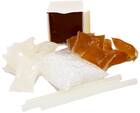
Packaging Flexibility: Available in sticks for manual dispenser guns, or in pellets and pillows for continuous automated dispensing systems.
Technical Comparison: Hot Melt vs. Solvent-Based Adhesive
This table allows you to visualise the operational differences to guide your choice according to your manufacturing process and substrates.
|
Technical Criterion |
Hot Melt Adhesive |
Solvent-Based Adhesive (Neoprene/Contact) |
|
Setting Speed |
Almost instantaneous (by cooling) |
Fast after evaporation (Flash-off) |
|
HSE Impact |
Solvent-free, odourless, VOC-free |
Strong odour, flammable, high VOCs |
|
Target Substrates |
Cardboard, Wood, Plastics, POS |
Multi-substrate, Rubber, Metal |
|
Application Method |
Heating gun or melter tank |
Brush, spatula, or spraying |
|
Cleaning |
Mechanical or specific products |
Specific solvents (ACRODIS range) |
FAQ: The Essentials on Hot Melt Adhesives
1. What is the difference between an EVA and a PUR Hot Melt adhesive?
EVA (Ethylene-Vinyl Acetate) adhesives are versatile and ideal for packaging. PUR (Polyurethane Reactive) adhesives offer far superior resistance to heat and moisture because they create an irreversible chemical bond after reacting with atmospheric humidity.
2. How to choose the right packaging (Sticks or Pellets)?
Sticks are perfect for maintenance operations or manual bonding with a hand-held gun. Pellets are designed for industrial melters for high-volume automated application.
3. Does Hot Melt adhesive adhere to difficult plastics (PE/PP)?
For low surface energy plastics, a standard hot melt adhesive may be limited. In these specific cases, we recommend consulting our range dedicated to difficult plastics, such as ACROBOND A 260 MP.
4. What is the shelf life of the ACROBOND range?
Thanks to their 100% solid composition, Hot Melt adhesives have an excellent shelf life, often ranging between 12 and 24 months, provided they are stored away from moisture and excessive temperatures.
5. Can Hot Melt dispensing be automated?
Absolutely. Our references are compatible with bead, dot, or spray dispensing systems on automated machinery. For precise two-component dispensing, please refer to our two-component pneumatic dispenser gun solutions.
Get a Personalised Recommendation
The choice of a Hot Melt adhesive must be validated according to your substrates and final temperature constraints. As a specialist in industrial adhesives for over 20 years, ACROM supports you in selecting the most adapted reference for your application. Contact us for a trial or a personalised technical study.